NEWS
Monthly insights to empower safer, smarter, and more sustainable organizations
.png)
Anti-Corruption Awareness: Building Integrity in Business
Corruption isn’t just a legal issue, it is a business risk that affects reputation, operations, and trust. Under the Malaysian Anti-Corruption Commission (MACC) Act 2009, companies and individuals can be held liable for bribery, false claims, or abuse of position.
Since 01-Jun-2020, Section 17A introduced corporate liability, meaning organizations can be prosecuted if employees or associated persons
engage in corrupt acts, even without management’s direct involvement. The only defence? Having adequate procedures in place.
Why The T.R.U.S.T Principles Is Essential?
It guide organizations to prevent corruption.
T – Top Level Commitment:
Leadership sets the tone for integrity.
R – Risk Assessment:
Identify and evaluate bribery risks.
U – Undertake Control Measures:Implement due diligence, approval limits, and reporting channels.
S – Systematic Review:
Audit and improve compliance programs.
T – Training & Communication: Build awareness across all levels.
Common red flags:
✔ procurement shortcuts
✔ excessive hospitality
✔ undisclosed relationships with vendors
These risks often arise in tendering, subcontractor management, and authority approvals, areas where transparency is crucial.
How We Can Support You?
IMD Management Consulting supports organizations in aligning with ISO 37001:2025 Anti-Bribery Management Systems, helping businesses map risks, implement controls, and foster a culture of integrity.
Contact us today to strengthen your anti‑bribery culture and safeguard your business future.
.png)
Why ISO 37001:2025 Matters to Your Business
ISO 37001:2025 is the international standard for Anti‑Bribery Management Systems (ABMS). It provides organizations with a structured framework to prevent, detect, and respond to bribery risks. By adopting this standard, businesses demonstrate their commitment to integrity, transparency, and ethical practices.
Why Awareness Is Essential
Bribery is not only a legal risk, it undermines trust, damages reputation, and erodes competitiveness. Awareness of ISO 37001:2025 ensures that leaders, employees, and stakeholders understand:
✔ The risks of bribery in procurement, tendering, subcontractor management, and authority interactions
✔ The importance of preventive controls, such as clear policies, due diligence, and reporting mechanisms
✔ The role of culture, where integrity and accountability are embedded into daily operations
Why ISO 37001:2025 Is Important to Business
Implementing ISO 37001:2025 goes beyond compliance. It strengthens your organization in several ways:
✔ Protects reputation by showing zero tolerance for unethical practices
✔ Builds stakeholder confidence with clients, regulators, and partners
✔ Reduces legal and financial risks linked to corruption cases
✔ Improves governance through structured policies and accountability
✔ Enhances competitiveness in major tenders and international markets
Creating a Culture of Integrity
Awareness programs are the first step toward successful implementation. Training sessions, workshops, and communication campaigns help employees recognize risks and understand their responsibilities. When awareness is high, organizations can move from reactive compliance to proactive integrity management.
How We Can Support You?
At IMD Management Consulting, we help organizations:
✔ Conduct awareness training for ISO 37001:2025
✔ Perform gap assessments against current practices
✔ Develop anti‑bribery policies and documentation
✔ Guide implementation and internal audits
✔ Prepare for certification readiness
Contact us today to strengthen your anti‑bribery culture and safeguard your business future.
ISO 14001:2026 Officially Published!
On 15 April 2026, the revised ISO 14001:2026 Environmental Management Systems (EMS) standard was officially released. This latest edition continues to provide organizations with a practical, internationally recognized framework to manage environmental responsibilities, address risks and opportunities, strengthen compliance, and improve overall environmental performance.
Suitable for Organizations of All Sizes
ISO 14001:2026 remains flexible and scalable. Whether you are a small business, medium-sized manufacturer, or multinational corporation, the framework can be tailored to your organization’s size, nature, and context. It can be implemented using existing processes and improved progressively over time.
Responding to Modern Environmental Challenges
As environmental issues grow more complex and interconnected, organizations face increasing expectations for transparency, accountability, and measurable results. The revised ISO 14001:2026 addresses these demands by enhancing the standard to better support today’s priorities:
✔ Climate change and resilience
✔ Biodiversity and ecosystem protection
✔ Resource efficiency and circular economy practices
✔ Pollution prevention and sustainable operations
✔ Stronger environmental governance and accountability
What’s New in ISO 14001:2026?
While the structure of the standard remains consistent with ISO 14001:2015, the 2026 edition introduces clearer, more practical requirements and guidance. Key improvements include:
✔ More practical guidance for implementation
✔ Stronger emphasis on current environmental issues and sustainability expectations
✔ Better integration of environmental management into business strategy and decision-making
✔ Greater focus on performance outcomes, not just systems and procedures
✔ Continued support for continual improvement and risk-based thinking
Why Transition to ISO 14001:2026?
Organizations adopting the new version can benefit from:
✔ Enhanced environmental credibility and stakeholder confidence
✔ Improved legal and regulatory readiness
✔ Better operational efficiency and waste reduction
✔ Stronger ESG and sustainability alignment
✔ Increased resilience to environmental and business risks
How We Can Support You?
We provide comprehensive support to help organizations transition smoothly to ISO 14001:2026, including:
✔ Awareness training and transition workshops
✔ Gap analysis and implementation support
✔ EMS documentation development
✔ Internal auditor training
✔ Certification readiness consultation
Contact us today to discuss how we can support your ISO 14001:2026 journey.
.png)
Myth vs Fact: Anti-Bribery in Business
❌ Myth 1:
“Anti-bribery certification is just paperwork.”
✅ Fact:
ISO 37001 builds a culture of integrity, transparency, and trust—opening doors to government projects and major tenders.
❌ Myth 2:
“Bribery risk only affects top management.”
✅ Fact:
Risks exist at every level—procurement, subcontractors, and daily operations. ISO 37001 ensures controls across the organization.
❌ Myth 3:
“Compliance is enough.”
✅ Fact:
Certification is not just about passing audits. It’s about embedding ethical practices that protect reputation and strengthen governance.
Lesson for Leaders:
Anti-bribery management isn’t a checkbox—it’s a competitive advantage. Companies that invest in ISO 37001 demonstrate credibility, reduce risks, and build lasting trust with clients and regulators.
At IMD Management Consulting, we guide contractors through every step—from gap assessment to certification readiness—ensuring a smooth journey to compliance and integrity.
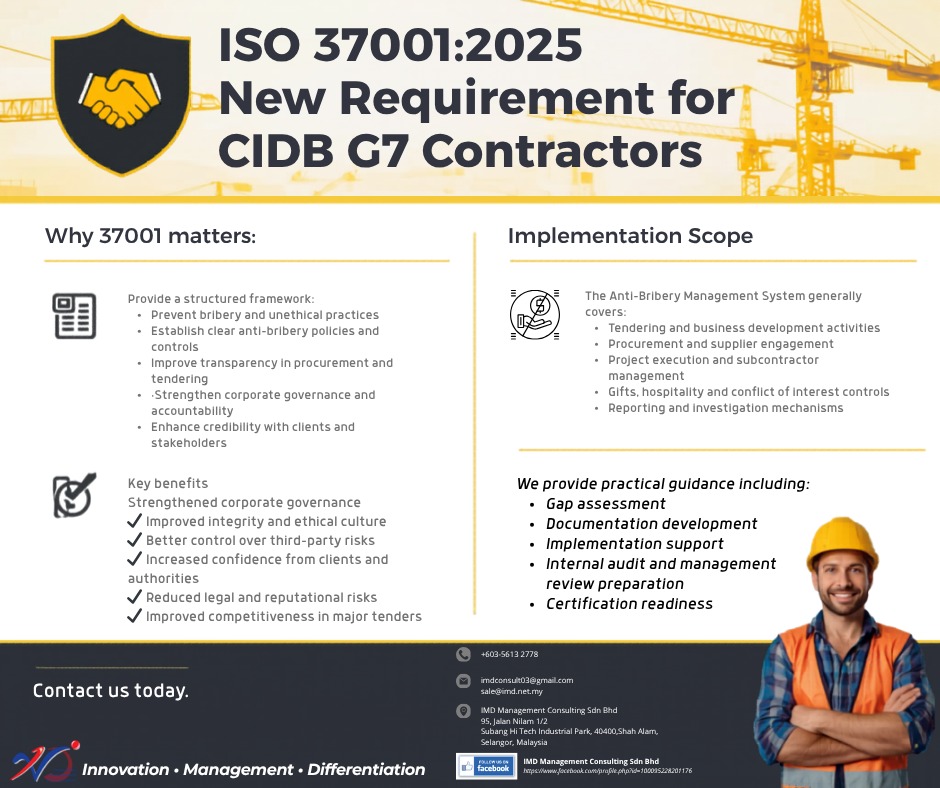
ISO 37001:2025 Anti-Bribery CertificationNew Requirement for CIDB G7 Contractors
The Construction Industry Development Board (CIDB) has introduced MS ISO 37001:2025 Anti-Bribery Management System (ABMS) as part of the governance and integrity strengthening initiative for contractors, particularly those under Grade G7 classification.
This milestone requirement is part of CIDB’s drive to strengthen governance, integrity, and ethical excellence in the construction industry.
Why ISO 37001 Matters?
Contractors face bribery risks in areas such as:
✔ Tendering & contract negotiations
✔ Procurement & subcontractor selection
✔ Project execution & variation approvals
✔ Inspections & authority interactions
✔ Maintenance contract renewals
ISO 37001 helps you:
✔ Stop bribery before it happens
✔ Build clear anti-bribery policies & controls
✔ Increase transparency in procurement & tendering
✔ Strengthen governance & accountability
✔ Earn trust from clients & stakeholders
Beyond Compliance – Business Advantages
ISO 37001 isn’t just about CIDB requirements. It also delivers:
✔ Stronger corporate governance & ethical culture
✔ Better control over third-party risks
✔ Greater confidence from clients & authorities
✔ Reduced legal & reputational risks
✔ Competitive edge in major tenders
It can also be integrated with ISO 9001, ISO 14001, and ISO 45001 for a unified management system.
Implementation Scope
Your Anti-Bribery Management System typically covers:
✔ Tendering & business development
✔ Procurement & supplier engagement
✔ Project execution & subcontractor management
✔ Gifts, hospitality & conflict of interest controls
✔ Reporting & investigation mechanisms
Typical implementation timeline: 6–9 months, depending on organization size and readiness.
How IMD Supports You
We provide end-to-end guidance to help contractors achieve certification smoothly:
✔ Gap assessment & readiness review
✔ Documentation development
✔ Implementation support & training
✔ Internal audit & management review preparation
✔ Certification readiness assistance
Contact IMD today to discuss CIDB requirements, implementation strategies, and certification timelines. Together, let’s build a culture of transparency, trust, and ethical excellence.
ISO 14001:2026 is Almost Here: What Your Organization Needs to Know
The world of Environmental Management Systems (EMS) is evolving. With the ISO committee’s approval of the Final Draft International Standard (FDIS), the official publication of ISO 14001:2026 is now scheduled for April 2026
For organizations currently certified, a three year transition period is expected. While the core Plan-Do-Check-Act (PDCA) framework remains unchanged, the 2026 revision introduces a stronger focus on sustainability, supply chain accountability, and climate resilience.
What’s Changing? The revision philosophy focuses on strengthening environmental relevance rather than a complete structural overhaul. Key updates include:
1. Climate & Context: Organizations must now consider broader issues like climate change, biodiversity, and resource availability within their "Context of the Organization" (Clause 4).
2. A Stronger Life Cycle Perspective: Your EMS now extends beyond your site boundaries to include raw material sourcing, supplier impacts, and product end-of-life.
3. New Change Management (Clause 6.3): A major structural addition requires organizations to formally evaluate and manage environmental impacts whenever new processes, materials, or technology upgrades are introduced.
4. Leadership & Governance: There is a heavier emphasis on top management being held accountable for integrating environmental performance into the core business strategy.
Preparing for Transition: To ensure a smooth move to the 2026 version, certified companies should begin reviewing their current systems:
a. Update Context Analysis: Incorporate climate and biodiversity risks.
b. Evaluate Aspect Lists: Include a wider life cycle perspective (upstream and downstream).
c. Strengthen Supplier Controls: Review how you manage environmental responsibilities across your supply chain.
d. Formalize Change Procedures: Ensure new facility expansions or process changes are evaluated for environmental impact.
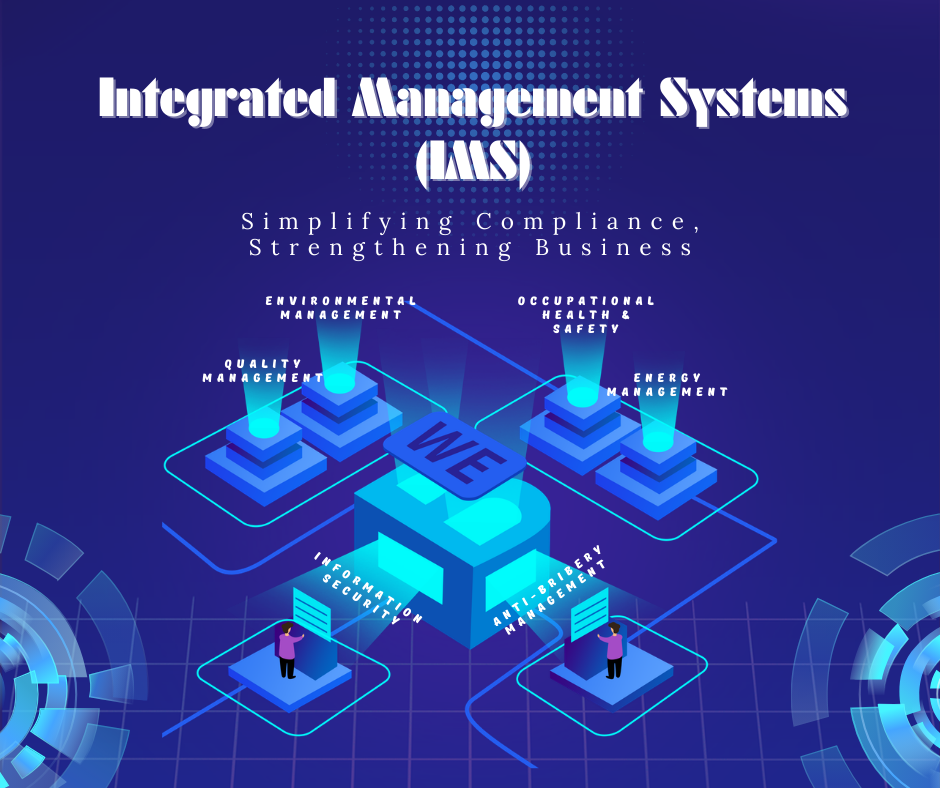
The Power of Integrated Management Systems (IMS): Simplifying Compliance, Strengthening Business
Managing multiple ISO standards separately can be overwhelming:
✔ ISO 9001 for Quality
✔ ISO 14001 for Environment
✔ ISO 45001 for Occupational Health & Safety
Each framework demands audits, documentation, and improvements—often in parallel, creating duplication and complexity.
Here’s the fact: Integrated Management Systems (IMS) combine these standards into one efficient approach.
With IMS, organizations benefit from:
✔ Consolidated audits – fewer disruptions, smoother processes
✔ Unified documentation – less duplication, clearer records
✔ Time savings – more focus on value‑adding work
✔ Cross‑department synergy – compliance becomes a shared culture
Industries from manufacturing to healthcare, IT, and food safety are already embracing IMS to stay agile and competitive.
At IMD Management Consulting, we help organizations design and implement IMS frameworks that reduce complexity while strengthening compliance.
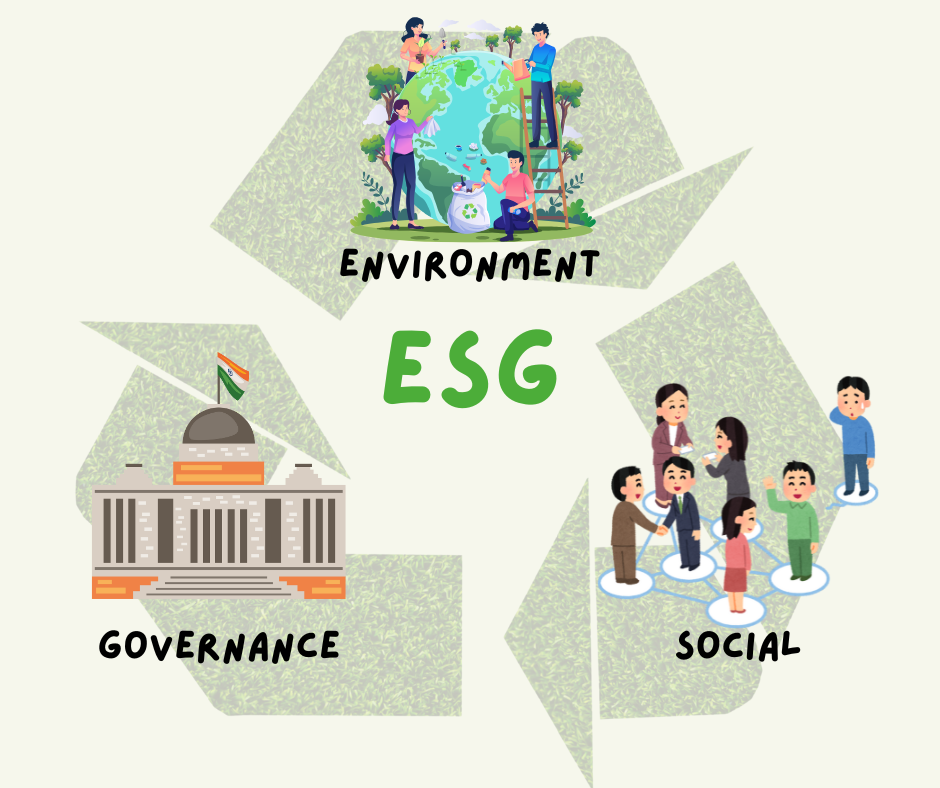
The Value of ESG in Modern Business: More than Compliance, It's Competitive Advantage
For many organizations, Environmental, Social & Governance (ESG) requirements feel like another layer of reporting. But the facts show otherwise:
Companies with strong ESG practices consistently attract more investors, secure better financing terms, and build stronger customer loyalty.
Why? Because ESG frameworks go beyond compliance, they demonstrate responsibility, resilience, and readiness for the future.
With ESG integration, organizations can:
✔ Reduce environmental impact through energy and carbon management
✔ Strengthen stakeholder trust with transparent governance
✔ Improve workforce engagement through social responsibility initiatives
Fact to Remember: ESG not just about ticking boxes, it is about proving your organization’s values in action.
At IMD Management Consulting, we help businesses embed ESG into their operations, aligning sustainability with profitability. Whether in manufacturing, healthcare, or services, ESG is becoming the language of credibility in every sector.